
Group Activities: Learning, Belonging and Getting Out of the House
Day programmes and community groups fill the week, but the first few weeks are the hard part and not every group is a good fit. Here is what these activities really involve and how to tell whether one is worth sticking with.
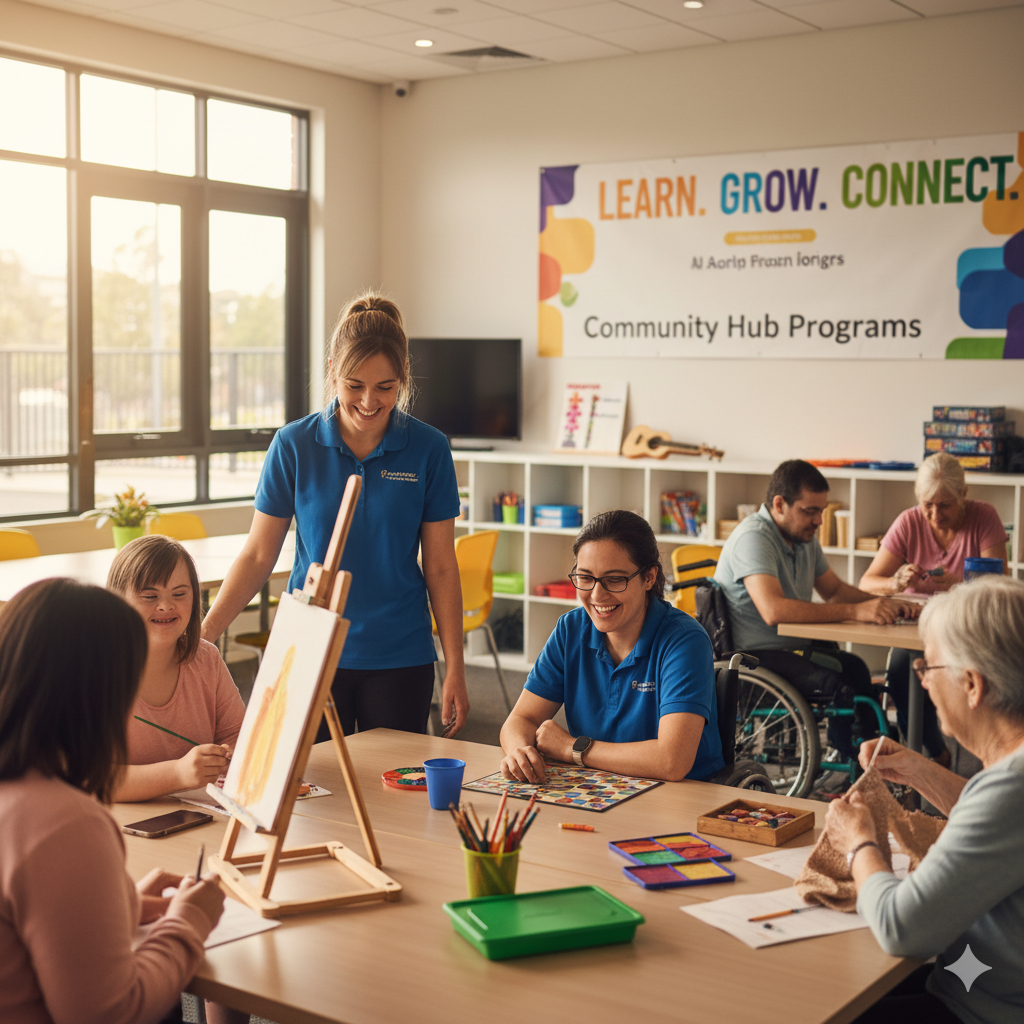
Someone sits in the car outside the community centre for eleven minutes before going in. The group is on the other side of a door, and everyone in there already knows each other. They have been to this building before. Today there is a new person in the corridor with a name tag on and nowhere to stand, and everyone is busy being friendly with a face they already recognise. It is a small, ordinary moment, and it is the part that decides whether somebody comes back next Thursday.
Group and centre-based activities sit under social and economic community participation, and they are among the most requested supports in the NDIS. They are also the support most likely to be set up quickly and reviewed late, and most likely to be quietly dropped after a bad month. This guide covers what these activities involve day to day, why routine and familiar faces matter more than people expect, what the first few weeks are really like, and how to judge whether a particular group suits you.
What group and centre-based support looks like
This is a broad category covering several quite different things. A day programme at a community centre, usually running a few days a week with a set structure, a familiar group, staff on hand and a mix of activities indoors. A skills or learning group, focused on something specific like cooking, art, music, technology or money management. A social or outing group that meets less often. A club membership with someone alongside while you take part in something that already existed before you arrived.
What they share is a room, a schedule and other people. What differs is everything that makes it worth going. A day programme with nothing to do is a corridor with a roof on it. A well-run group that keeps the same people coming back is doing something that is hard to fund and easy to overlook.
Social groups, and groups that teach something
People often use the word for both and are then disappointed by one of them. A social group exists for the company, the routine and the conversation. A skills or learning group has a purpose, and that purpose is the point. Both are legitimate. The mismatch is what hurts, and it is worth being honest with yourself about which one you are after before you spend a month in the other.
Skills groups carry a particular pressure that is not usually discussed. Being in a room where you are the least experienced person is uncomfortable for anyone and harder for some. If it is going to be useful, there has to be someone skilled there who is not busy catching others up. A group leader who treats every participant as though they will never get there will lose you within a term.
There is also a third option that gets skipped, which is a group built around something you already love. Photography, a walking group, a community choir, a gardening project. Nothing is being taught and nobody needs to be assessed. For a lot of participants this is the one that sticks, because the activity carries the social side rather than the other way around.
Why routine and familiar faces do more than you think
The value of a weekly group is not mainly the activity. It is that Thursday means the same thing every week. For someone whose days are otherwise unstructured, that is not a small benefit. It is the difference between getting dressed with a purpose and not.
Familiarity compounds. In the first month the group is a room full of strangers. By the sixth, the same three people are arriving at the same time and nodding at each other, and the group has started to hold conversations you were not part of when it began. That is the moment people describe as belonging, and it arrives later than anyone expects. Providers who describe a group as boring or low in engagement in the first few weeks are often describing a group that is working exactly as it should.
The first few weeks are the difficult part
Almost nobody enjoys the first two weeks. The room is unfamiliar, the routine is unknown, and there is a specific embarrassment in being the person who does not know where the toilet is, what time to arrive, whether to bring a pencil, or how to introduce themselves. That has a name and it is not reluctance, it is the ordinary discomfort of entering any new social setting, and it is much worse when you are the only person there who is different from everyone else.
It also helps to know what usually happens. Someone checks in by name. The group repeats something. A person you already met says hello. The leader remembers something you said three weeks ago. The activity takes longer than you expected and you are bad at it. All of this is normal, and none of it means the group is wrong for you.
The practical response is to make the first visits as small as possible. A single hour, arriving ten minutes late on purpose, sitting near the door so leaving early is easy, going with someone you already know, and having a plan to do something after so there is a reason to leave rather than a reason to stay. A support worker who can come for the first few sessions and then step back, in steps, is worth a great deal here.
What to bring, and how long sessions run
Ask the group before the first visit, because the requirements are specific and being turned away is avoidable. Common ones include a named medication if the group is out for a walk, a water bottle, a hat, a photo for a display board, an item for a craft activity, comfortable clothes for anything physical, and a change of clothes if there is a cooking or messy session. Some groups ask for a contribution towards materials, and some have a waitlist, so ask about both.
Sessions commonly run between one and three hours, once or twice a week, though full day programmes are common and run longer with breaks throughout. A long day needs planning rather than endurance, with somewhere quiet to go, clear information about lunch, and transport arranged for both the outward and the return journey. Exhaustion from a long day is the single most common reason a group placement ends up not working, and it is often presented as a loss of interest when it is really a pacing problem.
Telling whether a group is actually right for you
After a few weeks there is enough information to make a judgement, and it is worth making one deliberately rather than drifting. Some honest questions:
- Do I want to go back next week, even if the reason is only seeing people?
- Can I be myself here, or am I performing a version of myself that is exhausting
- Do the staff know my name and what I am interested in?
- Is there something I would like more of, and something I would drop?
- Would I be sad if this stopped, and if not, what does that tell me
Not every group should last forever. People move on from things that served them at one stage. But a group should be worth attending before you decide it was not, and the honest reason for leaving matters more to your plan than the group’s name does.
Getting a group that works for you
Choosing a group is not something to be handed. It involves visiting, asking direct questions about staff training, ratios, what happens when someone becomes distressed, and whether the same staff are there each week, and sometimes it involves a trial period that everyone acknowledges is a trial. A good provider will be comfortable with that conversation. A provider who wants you committed quickly is usually working to their own timetable rather than yours.
Orchid Premium Care supports participants with group and centre-based participation needs, including helping people find a group, arranging the support to attend, and keeping that support consistent as they settle in. Our team is happy to talk through what you want from a group, what would make you stop going, and what a realistic first month looks like. If you would rather describe your week to us before you commit to anything, that is a good place to start.
Want to talk about your support needs?
Every person's support plan is different. Our team can talk you through what is available, what your plan covers, and what the next step looks like. There is no obligation and no pressure.