
Community Nursing: Bringing Nursing Care to Home
Community nursing is nursing care delivered where you live rather than in a ward. Here is what a home visit can and cannot do, why the home setting matters, and who it suits.
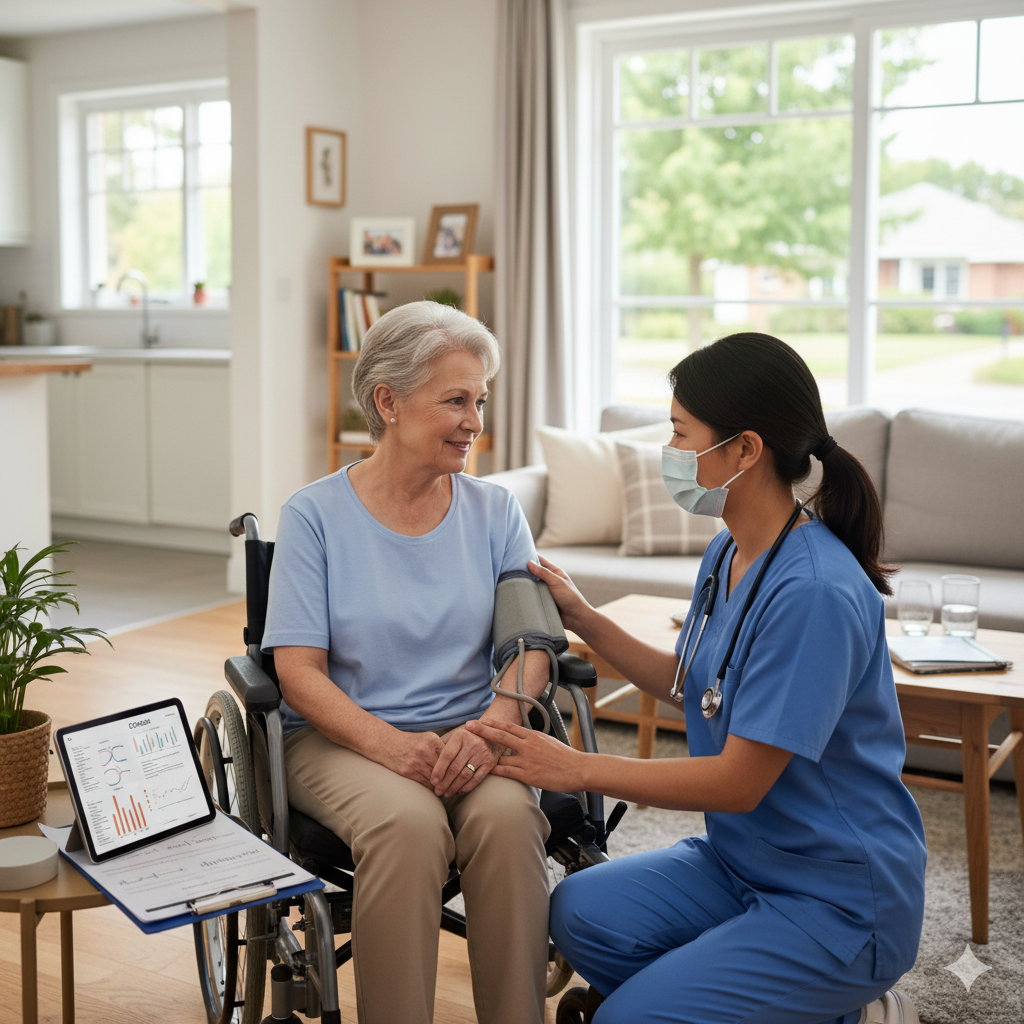
A hospital nurse is asking a participant where they usually sit during the day, how they get to the bathroom, what the bed is like, whether anyone helps with the shower, and what the kitchen looks like. None of that is in the notes. The person has been in the room for nine days and the notes say nothing at all about any of it.
That gap is the reason community nursing exists. A clinical assessment done in a hospital describes a person in a hospital bed. It does not describe the person who needs to manage at home on Sunday morning with the equipment they actually have and the support they actually have. A nurse who has been in the home changes what is recommended, often significantly, because the recommendations finally fit the life.
This article is about what community nursing is, how it works, and what it is and is not able to do. Everything in it is general information. The care you or your family member receives is a clinical matter for your own nurse and health professionals.
What community nursing actually is
Community nursing is registered nurse care delivered in a person’s home, or sometimes in a day setting such as a clinic. It grew out of the recognition that a great many hospital admissions happen not because somebody needs hospital care specifically, but because somebody needed skilled care and there was nowhere else for them to get it.
The people it serves are varied. Some have a long-term condition needing regular clinical monitoring at home. Some are recovering from illness or surgery and are expected to need care for weeks rather than days. Some have a disability requiring ongoing nursing support such as catheter care, wound care, or management of a medical device. Some are palliative, where the aim is comfort at home rather than treatment in a hospital.
What they share is that a nurse with the right skills can meet them where they are. Not every situation is one where home is safe, and a nurse assessing a new referral will be part of the conversation about whether home is the right place at all. That assessment is clinical, and it is a genuine part of the service rather than a formality.
How it differs from being in hospital
A hospital has people on site. Nurses, doctors, allied health, pharmacy, imaging, and the ability to escalate a decision within minutes. Home has none of that, and good community nursing is built with that fact at the centre of its thinking rather than treating the living room as a small hospital bay.
In practice this means more attention to what will actually happen. What happens if the nurse is delayed and a dressing needs changing sooner than planned. Who the participant calls at seven in the evening. Whether the family can manage the evening before the morning visit. Whether there is somewhere in the house where a sterile procedure can reasonably be done. A hospital does not have to answer those questions. A home service has to answer every one of them before the first visit.
It also changes the relationship. A nurse in a home sees the participant as a whole person in a household with a life in it, not as a bed. They see what a participant can do, what the place allows, and what a family is already carrying. That knowledge is clinically useful and it is also how you get care that is realistic rather than idealised on paper.
What a home nursing visit can and cannot do
Setting expectations here saves a lot of frustration. A community nurse can carry out nursing care in your home, assess and monitor, review progress against goals, teach and train, administer or supervise treatment as prescribed, provide or check equipment, dress wounds and manage devices, and escalate to other health professionals when something changes.
What a community nurse cannot do is diagnose and treat new conditions outside their scope, prescribe in the way a doctor does, perform procedures that require hospital or theatre facilities, replace urgent care, or substitute for a service that is not funded. Nor can a nurse be present continuously. A scheduled visit is not a resident worker, and anybody relying on nursing coverage overnight should understand that before it is arranged.
A visit may also be limited by what is safe or practical in the home on that day. That is not a failure. A nurse who says a procedure needs two people, or better lighting, or a different room, is managing risk properly, and it is a reasonable thing to plan for rather than be frustrated by.
Working alongside your GP and specialists
Community nursing sits inside a system, not apart from it. The GP is usually the coordinating clinician, and the community nurse is the person who sees change earliest because they are in the home several times a week and are the only clinician who sees the participant in their actual conditions.
That makes communication the part of the job that matters most. A nurse who notices something has changed and does not tell the GP is wasting the advantage they have. Documenting in a way that a doctor can act on, referring appropriately, and being honest when something is beyond the scope of community care are all part of good service.
It is reasonable for a participant to ask how a provider communicates with their GP, what happens when a nurse identifies a concern, and who they would call if they could not reach the nurse. Any provider worth having can answer those without hesitating.
Why seeing a person in their own environment matters
There is a practical clinical argument here that goes beyond comfort. Assumptions made in a ward are frequently wrong, and finding out why takes someone in the home.
A transfer that a nurse assumed required a hoist may not, once they see what the person actually does. A bathroom that looks accessible in a photograph may be unusable at night. A dressing schedule that looks reasonable on paper may be impossible for a participant who has appointments three days a week and no one at home in the morning. A medication routine that worked in hospital may depend on a rigid ward schedule that does not exist outside it.
Home visits also catch things a ward assessment cannot. Falls risk across a real floor. How the person actually transfers. Whether the hoist can fit through the door it has to fit through. Whether the fridge holds what the plan assumes. Whether the participant has told anybody they are struggling, which they often have not, because staff are around all the time and a spare conversation is hard to find.
Coordinating with your support workers
Most participants who need community nursing also have support workers, and the two supports work well together and badly together depending on how the boundaries are set. A participant who has a wound nurse twice a week and a support worker three times a day is a participant with two people observing the same situation, which is useful if they talk to each other and confusing if they do not.
The practical arrangement is a written division of responsibility. What the nurse does, what the support worker does, what the family does, what happens if a dressing becomes saturated before the next visit, and who gets told. It also means the support worker knows what to look for and when to escalate, which for clinical reasons is usually a short list.
There is a cultural dimension too. A participant who is relaxed with their support workers but anxious with clinical staff is a common pattern, and it changes how well the clinical care goes. A provider that pays attention to matching and to continuity does better here than one that treats the nursing as a separate service attached by a phone number.
Who this support is suitable for
Community nursing suits people who are living at home and have a clinical need that can be met there. In practice that includes ongoing nursing care for a disability or a chronic condition, wound and skin care, catheter and stoma care, management and monitoring of medical devices, medication administration where a nurse is required, end-of-life care at home, and post-discharge care where recovery is expected to take weeks.
It is not the right fit where somebody needs care that can only be given in hospital, or where the level of care required exceeds what a scheduled visiting service provides, or where there is nobody able to call for help if a nurse is not there. A good provider is willing to have that conversation honestly rather than taking on a referral that will not work.
The most useful thing a participant or family can bring to a first conversation is a plain description of the situation: what the health condition is, what happens on a normal day, what has already been tried, and what is going wrong. You do not need to know what the support is called to explain what you need.
Where to go next
If you are managing a health condition at home and feeling that the care you receive does not quite account for how you actually live, it is reasonable to ask whether community nursing would help. A conversation with your GP and your support coordinator is the useful starting point, and a provider can tell you quickly whether what you describe falls within what they can support.
Our team at Orchid Premium Care provides registered nurse care in the home, and we are happy to talk through your situation, what a home visit would involve, and where the gaps in your current support are. If we are not the right service for what you need, we will tell you and point you to who is.
Want to talk about your support needs?
Every person's support plan is different. Our team can talk you through what is available, what your plan covers, and what the next step looks like. There is no obligation and no pressure.